Monday, August 3, 2009

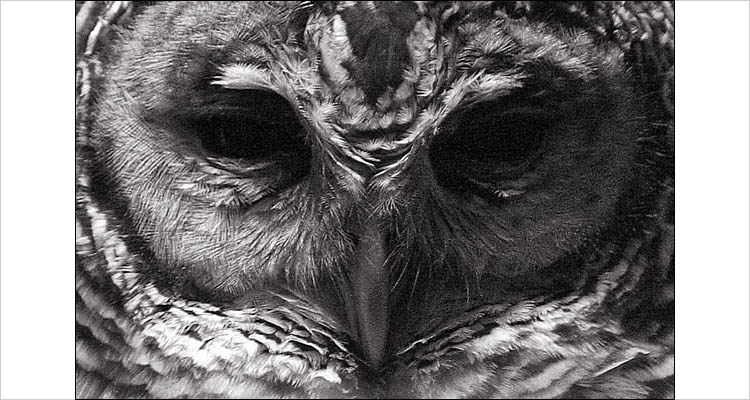
30 Days 30 Stories Installment 3, The Owl's Son

The Great Old Owl had a son. He was a bright, soft gray. Silvery in the moonlight, he flew with the grace of a night breeze, whispering through the bowing arches of the leafy forest and the still-warm summer fields.

The Old Owl was very proud of her son. His eyes were sharp and his dive was quick. He would watch the night when she was gone. As the sun rose, she told him stories of those before, the Old Ones, who were huge, flying to the moon and back, carrying the young humans to their home on earth, protecting them from the hurricane and the tidal wave.

Now they were only the Night Watchers, destined always for the shadows on the edges of the magic time - the shadows between day and night, history and future.

The Young One listened, quiet. He listened and he watched.

In the dusk, he rose early and went to the edge of the fields, where the People were. They moved slowly over the ground like squirrels on their hind legs, but they were tall and some were very big. He watched and watched. Until he saw her.

Her head was bright gold, her movement over the ground graceful as if she was floating. And when she turned in question to his hoot, her eyes were big and soft and dark. He was obsessed. He followed her into the day, his hours changing to catch more glimpses of her. She bathed in the cold stream in the early morning, and with his big, radiant eyes he watched her. She gathered thyme and rosemary in the meadows and along the sea, and flying low in the late afternoon, wings slow with sleep, he would come behind her.

She was a tall girl, and she was a dreamer. She watched, too, watched the others pairing off and moving to small homes, having small babies. She wanted a home, she wanted babies. But she also wanted her time in the fields, her time in the forest. She wandered the lanes and wondered if it would ever come, that time for hearth and fire, rather than the time for windy nights spent gazing at the crashing waves. Her legs were brown with sunlight when she realized the time had come, and her companion, the gray owl, grayer now and thin with longing watched it too. The boys came, the men came, a blur of animals to him, focused as he was on her - her golden hair, her soft brown eyes.

He came upon her one early morning, after hunting. She was weeping. He brought her a rabbit - fresh and white and beautiful. He had cleanly snapped its neck. It looked still alive, warm even to the touch. He longed to have it, he was very hungry. But he brought it to her and offered it to her and she gazed at it, not at him, and went back to weeping. When he awoke, nearly dead from hunger, in the evening, he saw it still upon her window sill, cold and wet with an autumn rain that had fallen. He took it away, ashamed, and ate it cold in penitence.

He stayed with her still. She came home one night with a man and he heard her cries - but they were not cries of pain. She was with the man for many years after that - but the Young One's ardor had not dimmed. What was a two-legged love to love like his, the love of a Watcher? He could not comprehend it, nor did he care. Only once, when a dark magpie came to sing in her window did he feel jealousy - for she listened to it, and cocking her head to the side, spoke to it. But he could not understand her words. He attacked it, and it lay dead in the forest not long later.

Many years went by, and the Young One became old. But he would not go with any owls, he had no time and little interest. He followed her, and he protected her with the beats of his wings in the sky. She was never alone in the night, and though she never needed it, he was there in her defense. Although he knew not what against. She was never alone - and moreover, neither was he.

She had turned as gray as he. She was like a ghost of herself - slowly moving through, haunting, her own house. She sat upon her house's steps and knitted near-sightedly, humming a little tune to herself. The man was not with her any more. He had disappeared one day while the owl was asleep in the rafters, and a new mound had appeared in the church yard. The Young One watched still, she was still as beautiful; though her hair was no longer bright, her eyes were still soft as the back of a caterpillar. Small people came and gathered around her, and she smiled and laughed at them. Some pointed, and babbled in his direction, but he took no notice. She turned around slowly, and for the second time in her life, she looked at him. She smiled once, into his eyes, and turned away again.

The next day, there was no movement in the house. In the night the old lady had passed, and outside her window, a very old gray owl lay, silent and dead.

Sunday, August 2, 2009

30 Days 30 Stories, Installment 2, The Grower

There was once a very cruel woman. She was unkind to her neighbors, nasty to her children, and generally difficult. She was very thin with a long, sharp face, hair pulled back in thin strings, and she wore a somewhat dirty apron at all times. She had no love; her husband, whom she had married from the necessity of their being no more room at her parents' house (8 children and another on the way) had died in his sleep, suddenly, when their children were still children. She always thought it unfair he had died in his sleep, peacefully, when she was left with a violent and brutal world. A good accident would have been so much more satisfying.

As it was, and as aforementioned, she had no love. But she did lavish care and gentleness upon one thing - in fact, a set of things. She had a garden of sorts, which she tended with care. Truly, it was just two strict lines of flower beds, and within them she planted very neatly the seeds. But she cared for it nonetheless. The two raised rows were always fresh and without weeds. She spent hours of her days in the garden, weeding and laboring and watering. However, nothing ever grew. She worked and worked and worked. She never gave up. In fact, it was in her garden that her daughter found her, slumped over a trowel, quite dead. By that time, her hair was an iron gray, and her gaunt figure yet gaunter in a worn-out brown sack dress. Her daughter laid her to rest beside her husband, the family cried as was customary, and then carried on.

The daughter was nothing like her mother. She was playful and carefree. She had escaped the stern, angry words of her mother and the lashing tongue to play in the woods and the fields. She had taken to her heels instead of bandying arguments about the little stone cottage. And it had served her well. Her heart was open, and her mind was clear (if a little anti-social from all that woods-wandering). Her brother, a tall, severe man, had moved to the city and appeared in a fine dark suit to the funeral, curtly paid his respects, and promptly removed himself again.

Charlotte, for her name was Charlotte, returned from her job and her shared room with other singles in the Upper Middleton, and went back to Little Middleton, and her mother's house, to get it ready for selling. She didn't really know what needed to be done, but thought that she should probably do it, nevertheless. She laughed at the cat, cranky and arthritic, who nevertheless greeted her with purrs, and she laughed when he brought her a fieldmouse. She laughed at the birds who sang in the trees, and she began to see what she must do to settle the house.

The house was quite in order. Her mother had been perhaps a mean woman, but an incredibly clean one. All the linens were laundered and mended, all the dishes washed and put away, there was a thin layer of dust about the place, but other than that, there was nothing needed doing. Charlotte sighed. She really wished there was just one thing she could do for the memory of her, the woman who bore her. She glanced out in the fields. And there she saw the garden. It had become overgrown and rather sad-looking in the three weeks it had taken her to settle her life and come to Little Middleton, and to the cottage. The rows of dark earth were graying in the sun, weeds had taken hold in the prime soil, and there were blackberry vines creeping in already. She sighed. Her mother had never found any luck in the garden - but... but... it was something Charlotte could do. She took her mother's garden basket, austere and worn, and carried it with her to the garden.

She weeded and watered and pruned, and soon it looked lovely. Absolutely lovely, clean and neat just as her mother had had it her life. And Charlotte smiled a sad smile, and rose up off her knees, stiff from sitting, and went in to dinner.

It was a few days later that Charlotte noticed, with not a little surprise, that there seemed to be seedlings starting in the garden. Her heart caught in her throat, and she choked her surprise. She was soon to be seen carefully spreading netting over the garden, warding off birds, and watching. A week later, the flowers had sprouted well. Rose bushes, poppies, and lavender came up with a mad abandon. The flowers were intense and pure. The smell was beautiful. Never had two rows of earth seemed so full of growing life. Charlotte watched and weeded. Then she called her brother.

They looked at the garden together. They looked at each other. It was about ten minutes later, as she wandered through the garden, that Charlotte realized her brother was crying silently. She went to him, put her arms around him, and sighed.

Together, they took the flowers from the garden, and put a bunch upon her grave. And the flowers there, from seed no doubt, took root and grew. They grew and filled the churchyard. At Charlotte's wedding some years later, it was the smell of lavender and roses that blessed the ceremony, and at the death of her brother many years after that, lavender and vine roses covered his grave in weeping wreaths.

Friday, July 31, 2009

The Short Story Project, Installment 1, Darkness

This is actually installment 2, but nevermind. 30 days, 30 stories - that's my goal. Hopefully this will help me beef up my writing comfort and accuity!

It was always sunny. The high, noonday sun. And by always I mean every single day, all day, no night. There were no stars, no moon, just the endless arc of blue that was the summer sky. And as much as I wished for some gloaming, evening, something to break the monotony, it would not come. The only thing that changed was the temperature. Sometimes it was a little cooler, sometimes a little warmer. This was how I mapped my days. And by the hours I went to work, the clocks that clicked by on all the walls. But three in the morning was just like three in the afternoon - work became an every-other-day affair.

I asked other people if they missed it. I asked them if they were as tired as I was. I was always tired. But they looked at me concerned for my mental health and asked me if I was joking. They laughed or shook their heads and affirmed the weather was great and they were going jet skiing with their boyfriend later. I felt like I was going to cry.

I was always tired. Tired and I missed the dark. I missed the shadows between dark and light, I missed the way the shadows from the trees emerged, danced around them slowly, and then merged into a blanket. The way the night breezes seemed to sigh in their sleep, as if the whole earth was dreaming, or on some nights it was as if the winds were awake rather than asleep, dancing and shouting and partying the night away. I missed the stars and the heavens, and the way they seemed to revolve around me. I missed the vastness of a dark heaven and began to hate the ever-closed blue of a sky, sometimes with clouds scudding through it listlessly.

I don't know how this happened, whether it was sudden or gradual. I couldn't really remember, but I knew I remembered a time before. And I knew I was exhausted. And I knew that others didn't seem to care.

One night - that is, one gap day, I went to the library looking for respite. There was no rest at home. The daytime tv went all day now. There was no evening programming because there was no evening. The library never closed because it was always day. So I went inside and sat down in a desolate chair. There were a few other people there, but almost everyone was out enjoying the weather, having picnics, taking hikes. I didn't want to picnic and a hike without a tent and a fire and ghost stories seemed less than thrilling.

I looked around listlessly, wandering from aisle to aisle. In the library I could pretend the dark still existed, because it was generally flourescent there anyway. I wandered into the back stacks. Into the stacks near the custodian's closet where I didn't usually go. And there, stacked higgledy-piggledy in a little alcove that seemed destined originally for a drinking fountain or a copier, there was a stack of shiny-covered volumes, with names like 'Astronomy through the Ages' and 'The Night Sky.' I was elated, and grabbing an armful, scurried off to a nearby corner to peruse.

I did peruse. I lost myself in visions of space and darkness, of the nighttime that everyone seemed to have forgotten. In love with visions of stars I remembered from frosty wintry nights, from times around Christmas when I would slip out on the deck and take in the bright starlights, I flipped endlessly through pages covered in the darkness that I longed for.

Many weeks I spent like this, wandering in the annals of an age disappeared, until I knew every crevice of each picture, every detail of each star. The position of the arc of night in summer and winter, spring and fall. I touched and watched the pictures, the static recollections of a camera, trying to capture something so very timeless and yet so very alive.

I was home one gap-day, sick. I had gotten into the habit of getting sick. I missed my nights of rest and my body couldn't handle the way the sun beat down on it, flooding it with UV from noon to midnight and back again. I lay in bed, miserable, trying to block out the light until, in a feverish mood, I thought to paint the sky I loved upon my windows. I wanted it so. And so from memory I painted - painted it in winter, with some clouds billowing from the South, in the wintry winds, in fall, when the winds were wild and hedonistic, settling into their icy selves of the later months and then revolting, in the summer, when stars blinked at the impertinence of the sun to take up so much of the day, and in the spring when the stars were soft and hopeful, kindly giants smiling on the pregnant earth.

I painted and I hummed a tune to myself. And then I fell asleep, asleep in a revolving world of night when all was peaceful, filled with lights and lightningbugs, and the soughing softness of night breezes. When evening came to fill up the houses with the shadows that it amassed outside their doors. And I dreamed until I awoke, with a start, to a stygian dark.

Rushing outdoors, I realized that my dreams had come. The dark had fallen to the ground and covered it. There, in the sky, hung the stars - shining as they always had. Timeless.

How much of their history had I lost in my days of light? I don't know. But I know that darkness, as well as light, is my dear dear friend.

Wednesday, October 29, 2008

Coffee/Roses

There were going to be roses
In the coffee in the morning,
And snowflakes lighting
Upon our window panes.

I was going to read books
By authors well-known
And the leaves of autumn
Would slowly fall down

In the morning it was
To be cold with breaths of fog
And in the afternoon's sun
I was to sit and sing.

But every moment now
We'll live together running
Not a silent second
But actions bright and torn.

Every thought desired
To sit in stained-glass light
Now there will be Christmas
Without silence, flames, and song

I would have shown you
Handfuls of birds
Thrown up in the sky
Now there will be dirt, glass, lye

Naples in winter.

I Want a Guitar

I want a guitar to travel
I want a guitar to free my feet
I want a guitar to take me there
I want a guitar to make me hurt.
In the evening I would go home
To a place unknown, take out
The guitar I know, and make
A strumming hum familiar.
The fingers of each hand
Would wander thoroughly each wire
And my voice would roam
Each soft, uncommon word.
Something gray becomes of
Thoughts that can't sing.
Music is not born it's made
Tomorrow I will go to different
Lands on it. make a boat of it.
And go.

I want a guitar to travel

Saturday, October 25, 2008

...

The world was a modern, unterrifying place until the accident.
After that date, everything changed. She changed. No more pretty trees, no more stars that shone high up in the sky. Everything was askew.
Before the accident she hadn't wanted anything. After, she wanted everything she couldn't have. She couldn't have much.
The world became one of wanting, wanting, wanting.
After the accident everything had changed.
A world of daisies became a world of primordial, insurmountable mysteries. A whole series of evil conundrums opening up every day. Normal. Ha.
Everything had changed. She had changed. The world wasn't the same, it didn't look the same. They weren't the same eyes anymore - the viewpoint had skewed.
The world had gotten in a terrible accident.

Saturday, March 22, 2008

Counting

Counting

Growing golden on the hours of love
Mead, sweet honey,
Flesh of my darling

Twice drunken on the liquor
Of his lips, the valor of his
Tongue

Thrice fainted on the shores
Of his embrace
Tight around my waist

Four times drowned in the
Seas of his eyes
Four times lost in the
Waters of his soul

Five days pass like hours
Dance by like falling flowers
The molten sand of our time
Winds together; glass now flaming

Six months approach
Beckoning, betraying
How I long to dive far towards them
Through the dark I’ll find him

Seven times seven
Times seven my love grows;
Seas of time,
Glassy waters and stormy troughs